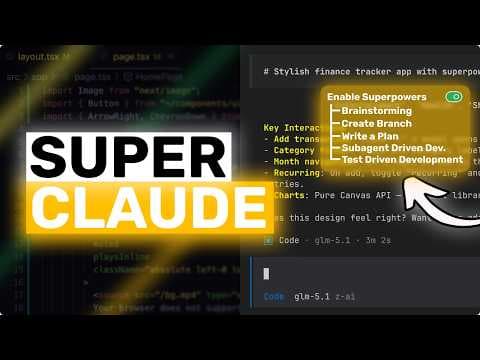
Superpowers робить AI‑кодер дисциплінованим партнером для CEO
Відео розповідає про репозиторій Superpowers – методологію, яка навчає AI‑кодерів спочатку уточнювати завдання, планувати, писати код за TDD‑циклом і проходити код‑рев’ю, а не просто «сліпити» код. Це робить агенти таких інструментів, як Claude Code або Kilo CLI, більш надійними та передбачуваними. Метод є модельно‑незалежним і легко інтегрується в різні середовища через навички або власні суб‑агенти.
Ключові тези
- Superpowers надає агентний workflow, який вимушує AI‑кодерів уточнювати специфікації, планувати, дотримуватись TDD, проходити код‑рев’ю і завершувати гілку чисто.
- Метод є модельно‑незалежним і працює з Claude Code, Codex, Gemini CLI, Kilo CLI (через конфігурацію OpenCode) та Verdant.
- Він перетворює AI‑стажерів у дисциплінованих інженер‑асистентів, зменшуючи спагеті‑код і підвищуючи надійність.
- Встановлення просте через офіційні маркетплейси або ручне додавання папки навичок, що робить його plug‑and‑play для багатьох терміналів.
🟢 Компанії можуть швидко впровадити Superpowers у свої CI/CD пайплайни, отримувати більш передбачувані AI‑генеровані зміни та скорочувати код‑рев’ю на 30 %. 🟢 Навчання junior‑розробників на такому workflow підвищує їхню продуктивність та зменшує залежність від senior‑інженерів. 🔴 Якщо команда не слідує процесу і пропускає кроки планування, переваги зникають, а AI може генерувати ще більше помилок. 🔴 Залежність від сторонніх навичок може створити vendor lock‑in, якщо репозиторій зупинить оновлення.
Хоча автор позиціонує Superpowers як «безкоштовний» шлях, повне використання вимагає часу на налаштування навичок і можливо придбання платних розширень у деяких IDE. Крім того, ефективність методу залежить від якості початкової специфікації – якщо вона нечітка, навіть найкращий workflow не допоможе. Таким чином, реальна цінність полягає не в інструменті, а в дисципліні команди.
Опис відео▼
[music] Hi, welcome to another video. So today I want to talk about a GitHub repo that is way more important than at first looks. It is called Superpowers by Ora. And if you just glance at it, you might think, okay, this is another prompt pack, another plugin, another little productivity trick for Claude Code. But that is not really what this is. Superpowers is basically an agentic software development methodology packaged as skills. It teaches your coding agent to stop acting like a fast intern and start acting more like a disciplined development workflow. And that difference matters a lot. According to the repo, the workflow starts before code gets written at all. It pushes the agent to brainstorm, clarify the spec, show you the design in digestible chunks, write an implementation plan, use git work trees, dispatch sub aents, follow actual red green TDD, request code review, and then finish the branch cleanly. And if you have been using AI coding tools for a while, you already know why this is a big deal. The default behavior for most agents is still basically hear request, write a bunch of code, sound confident, pray later. Superpowers is trying to fix that. And that is also why this matters beyond clawed code. If a tool supports skills, rules, sub aents, or even just strong instruction files, there's a good chance you can bring a lot of this workflow over. Thank you. First, let me explain why I think this repo is interesting. The really important idea here is that the magic is not tied to one model. It is not Claude is smarter now or codec's got a new mode. It is the workflow. It's it is the reusable engineering behavior that is what makes this powerful. If you look at the official readme superpowers already has real integration paths for claude code cursor codeex open code and Gemini CLI. So this is not just theoretical it is already shipping in multiple environments for cloud code. This is the easiest story. Superpowers is is available through the official cloud plug-in marketplace and there's also the separate superpowers marketplace path. So if you live inside Claude code, this is pretty much plugandplay. Install it, restart, and and the idea is that Claude starts using those skills automatically when the task matches. Codeex is also interesting because the repo has a specific codec install flow. The official docs say to either tell Codex to fetch and follow the install instructions or do the manual version yourself by cloning the repo and linking the skills folder into Codex's native skills directory. And that part is really cool because it means superpowers is not fighting CEX. It is using Codex's own skill discovery model. So in Codex, this ends up feeling less like a hack and more like a proper extension of the agent. You're basically giving Codex a better operating manual for how to do software development. Now Kilo CLI is where it starts getting more interesting. Kilo is not listed in the superpowers readme as a first class one command installed the way Claude code is. So I want to be accurate here. This is not me saying there's already some separate official superpowers for kilo installer in the repo, but the practical answer is actually pretty simple. Kilo CLI is an open code fork and it works with the open code configs. So when people ask, can superpowers work in Kilo CLI? The practical answer is yes. Just do the open code style setup. That is what makes this so interesting. You're not reverse engineering some brand new integration path. You're not waiting for a separate marketplace listing. If you already understand how superpowers plugs into open code, you can carry that same config logic straight into Kilo CLI. So this is kind of great and I think this matters a lot because Kilo CLI users are usually the people who want speed control and a very clean terminal workflow. They do not necessarily want a giant UI. They do not want to click around a bunch of panels. They want the agent in the shell, the config and files and the workflow under their control. Superpowers fits that mindset really well because once it is wired in, Kilo CLI stops being just a fast terminal coder and starts behaving more like a disciplined engineering assistant. So what does that actually mean in practice? Let me paint the picture. Say I'm inside Kilo CLI and I ask it to add a billing dashboard to a SAS app. Without superpowers, a lot of agents will immediately start coding. They create tables, routes, UI components, maybe a web hook handler all at once, and you're just sitting there hoping the whole thing does not become a spaghetti mask. With superpowers in the loop, the flow changes. Instead of blindly coding, kilo sick lie starts by clarifying the spec. Do we need subscriptions or one-time payments? Should upgrades be immediate or prrated? How do cancellations work? What is the source of truth for billing state? Which edge cases do we actually care about right now? That is already a huge upgrade. Then once the scope is clear, the workflow moves into planning. Not vague planning, real implementation planning, small tasks, clear checkpoints, specific files, verification steps, maybe a work tree. If the change is risky, maybe a review step before the next phase. This is where superpowers shines. It forces a rhythm onto the agent. Brainstorm first plan, second implement in controlled chunks, verify, review, finish cleanly, and in a terminal tool like Kilo CLI that feels especially good because everything stays lightweight. You get the process without losing the speed. You get the discipline without turning your workflow into something bloated. That is why I think Kilo CLI is such a strong fit here. It gives you the open code compatibility story on one side and the terminal first developer experience on the other. Now, I also want to place Kilo in context with the other tools mentioned in the repo. Claude Code is probably still the easiest on-ramp. There is a cleaner install story there, and for a lot of people, that is going to be the fastest way to try superpowers at all. Codeex is also a really strong fit because the native skills setup makes it feel first class. You're not faking support. You are using Codeex the way it wants to be extended. Gemini CLI is important, too, because it proves this is not just a clawed thing or a CEX thing. Superpowers is trying to be model agnostic. It is trying to make the workflow portable. But Kilo CLI is the one I would highlight for people who love the terminal and want something pragmatic, not wait for the official Kilo package someday. More like if the open code config works, you can use that path right now, which is pretty good for sure. Now, briefly, I also want to talk about Verdant because I do think it can carry the same philosophy just in a different way. Verdant is not the same kind of story as Kilo CLI. With Kilo, the appeal is compatibility. With Verdant, the appeal is orchestration. There is no simple just use the open code config explanation there. But Verdant has something else going for it. Its docs talk about rules, custom sub aents, MCP integration, and git-based workspace isolation. So instead of installing superpowers in the same way, you can translate the methodology into Verdan's own building blocks. That means the brainstorming part can live in verdant.mmd or agents.mmd. The plan discipline can live in plan MD. The review mindset can live in custom sub aents. And the workree logic fits naturally because verdant already leans into isolated workspaces. So if kilo CLI is the easy compatibility play, Verdant is the more custom higher orchestration play. You're not saying how do I copy this install exactly. You're saying how do I make Verdant behave according to the same engineering discipline. And that is still really interesting because it shows that superpowers is bigger than one tool. It is a transferable way of working. So let me give you the short version. Superpowers is one of the most important AI coding repos right now because it shifts the focus away from model warship and toward reusable development process. Claude code is the easiest entry point. Codeex shows how clean native skill discovery can feel. Then Gemini reinforces the idea that this workflow can travel across ecosystems. Kilo CLI is probably the most practical terminal first adaptation because the open code compatibility story makes the setup very straightforward and Verdon is still worth mentioning because even without that same compatibility shortcut, it has enough structure to absorb the methodology through rules, sub aents and workspaces. If you are a kilo CLI user, I would seriously look at superpowers through the open code setup and just run with it. The big win is not some flashy install trick. The big win is that your agent starts behaving like it has an actual development process. I think that is the real value here. Overall, it's pretty cool. Anyway, let me know your thoughts in the comments. If you like this video, consider donating through [music] the super thanks option or becoming a member by clicking the join button. Also, give [music] this video a thumbs up and subscribe to my channel. I'll see you in the next one. Until then, bye.
Ще з цього каналу
UNLIMITED FREE MiniMax M2.7 + Hermes,OpenCode,Claude Code: This is THE BEST UNLIMITED FREE AI Coder!
близько 7 годин тому
Multica: This OPENSOURCE GUI CONVERTS AI Coding Agents into TEAMMATES!
1 день тому
Karpathy-Skill + Claude Code,OpenCode: This SIMPLE ONE-FILE SKILL Makes YOUR AI CODER WAY BETTER!
2 днi тому
Hermes V0.8 (New Upgrades) + New Free APIs & Local Models: LOL OPENCLAW! This is JUST SO BETTER NOW!
3 днi тому