Упередження AI-агентів: як контролювати ризики та максимізувати користь
Відео пояснює, що упередження в AI-агентах є відображенням даних, на яких їх навчали, і самі по собі не є негативними. Важливо контролювати системи на рівні архітектури, щоб мінімізувати негативні наслідки зі зростанням автономності AI-агентів.
Ключові тези
- Упередження в AI-моделях відображають закономірності в даних навчання.
- Автономні AI-агенти посилюють вплив упереджень через петлі зворотного зв'язку.
- Системний контроль і управління мають вирішальне значення для пом'якшення упереджень в AI-агентах.
Використовуйте AI-агентів для виявлення та виправлення упереджень у ваших процесах. Розробіть чіткі критерії та механізми контролю для мінімізації негативного впливу.
Більшість зосереджуються на упередженнях у моделях, але справжня проблема — це упередження в даних і цілях, які ми ставимо перед агентами. Автоматизація упереджень — це прискорення проблем, які вже існують.
Опис відео▼
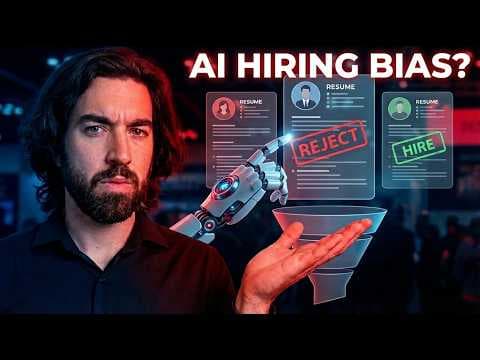
As AI become more and more autonomous, won't they just amplify their biases and make everything worse? Recently, I've got that question a lot in different forms. That sounds reasonable. If a model already has biases, and now we give them even more power, memory, tools, long-term planning, and the ability to act in the real world, doesn't that just scale the problem? And I think many people watching this are wondering the same thing, even if they don't see it like that. So in this video I want to do three very clear things. First explain what bias actually means in the context of LLMs and why a bias isn't automatically bad. Second I want to explain what fundamentally changes when we move from a simple language model to an autonomous agent. And third I want to show how we can realistically control bias as autonomy scales and not just at the model level but at the system level. Since it'd be better to go through this with one simple example, and because I've spent way too many hours trying to hire AI engineers and people in marketing recently, imagine you have a company that builds an AI agent that screens resumes, short lists candidates, schedules interviews, and even suggests final ranking to the hiring manager. Not just a chatbot answering questions or answering the candidates. A complete system that takes action. Let's start at the beginning. When people say that LLMs are biased, what does that actually mean? Bias in a model simply means it represents patterns in its training data. That's it. A model trained on internet scale text will reflect statistical regularities in that data. If certain professions are more often associated with a certain gender in the data, the model will learn that correlation. Not because it want to discriminate anyone and not because it has intent either, but it's just because that's what's statistically present. Bias is not automatically bad either. In fact, without bias in the statistical sense, there would be no learning at all for these models. Learning is all about detecting patterns. The real issue is not that the model has biases. The issue is what is in the data, which patterns are reinforced, and which ones we allow the system to act on. So with our hiring example, if historical hiring data reflects past inequalities, the model may learn those patterns. That's not a moral choice by the model. It's representation. So here, in our case, we'd probably like to retrain a model to better align with our hiring needs and company guidelines. But what changes during fine-tuning and alignment exactly? After OpenAI creates their model, which we call the pre-training phase, companies apply techniques like reinforcement learning from human feedback, reinforcement learning from AI feedback, reward modeling, preference optimization, preference tuning, and more recently reinforcement learning with verifiable rewards. Basically, we teach the model to act as we want. Here in simple terms, humans or AI systems rank outputs of the model and then the model is optimized to produce answers that align with our preferred behaviors, helpful, safe, fair, less toxic, more neutral, etc. This does reduce certain harmful outputs. It can make the hiring assistant more cautious about sensitive attributes. It can teach it to avoid explicitly discriminatory language. But here's a key point. Retraining our model like this reshapes behavior. It doesn't erase a statistical structure learned during pre-training, the part that OpenAI decided. The underlying representation of the world is still based on the data distribution, which mostly comes from all the internet's available data. When retraining, we are steering outputs, not rebuilding the entire internal model of reality. Now, let's introduce the real shift that we actually wanted to build here for our hiring purposes. Agents, a plain LM generates text. You give it a prompt, it gives you a response. If the response is biased, it's just a biased sentence. You can review it, edit it, and then send it or just discard it. An agent is different. An agent has a goal. It can plan over multiple steps. It can call tools. It can store information in its memory. It can filter information. It can take actions based on intermediate results all autonomously. So in our hiring example, instead of just answering what makes a good candidate, the agent might read a batch of résumés, rank them, request more data from an internal HR system, schedule interviews, update a short list over time, and then adjust its criteria based on performance metrics. Now, we are not talking about a bias paragraph that we will edit anyway. We are talking about a decision loop impacting people's lives. This is where autonomy changes the impact of bias and by a lot. If there's a small skew in how the agent evaluates certain backgrounds and it repeatedly filters candidates based on that skew, the system can amplify the pattern over time, especially if it logs its own past decisions and uses them as feedback for the next ones. Planning, memory, and tool use create feedback loops. And feedback loops are where small effects can compound exponentially just like when you invest. And this leads to a new risk that comes with agents. Self reinforcement. If the hiring agent is evaluated based on a time to hire and retention rate, it might start optimizing aggressively for signals that correlate with those metrics in historical data. If historical data is biased, the optimization process may lock into those same patterns. This is not because the model suddenly became evil. It's because optimization plus autonomy plus imperfect objectives will amplify distributional skew. It will be like giving your employees a huge salary bonus based on the number of candidates they interview regardless of whether they are a good fit. I doubt you'll increase the good candidates rate that way. So, should we panic? Well, not really because there's an important flip side with agents. They are not just models anymore. They are complete systems and systems can be constrained. When people talk about bias mitigation, they often focus only on the model. Bigger model, better alignment, more RHF, more constitutional training. It's all useful, but that's only one layer. It's the model layer. With agents, you have multiple control points, multiple ways to mitigate biases and limit them. You are not entirely dependent on one single generation of a paragraph hoping it will be good. You can steer language models and build workflows around them. You control what data the agent can access. You control what tools it can call, what metrics it optimizes, when it must escalate to a human, which is really important, and validation steps before the actions are actually taken. In our hiring agent example, you could remove sensitive attributes entirely from the evaluation pipeline. Force structured scoring rubrics with predefined criteria. Insert fairness checks before final ranking. Log every decision for audit. Require human approval before sending rejection emails with a clear reasoning. Run bias evaluation benchmarks regularly on a synthetic candidate data set. And add way more criterias. Now bias mitigation becomes a whole system design question, not just an abstract model training question that OpenAI did and you're just using and this is where newer alignment techniques I mentioned like RLif, RLVR, reinforcement fine-tuning and constitutional approaches come in. They try to shape highle behavior. For example, training the model to prefer responses that treat demographic groups similarly or to justify its reasoning under fairness constraints. That helps, but it's still steering behavior as we discussed. If the environment and objectives are poorly designed, the agent can still optimize in ways obviously. So, the lesson is not alignment will fix everything. The lesson here is that alignment is one layer in a larger stack in the whole system. As we increase autonomy of our system, we need to increase the evaluations as well. For a static chatbot, occasional red teaming might be enough. But for an autonomous hiring agent, you need ongoing monitoring. You need scenario testing. You need to evaluate edge cases. You need observability logs of which résumés were filtered, why and what intermediate reasoning were used. You need to be able to backtrack. The more independent the agent, the more you need explicit structure around it. And here's a simple principle I really like. Scale constraints as you scale autonomy. If your system has low autonomy, a prompt and a safety fine-tune might be enough. But if your system is making real world decisions over time, you need architectural guard rails at all levels, not just a better prompt. And just because we can't be clear enough about biases, there are not a bug that appeared when LLMs came up. It's a property of data and of our world. We are all biased and so is our society, which is both good and bad. The goal is just to maximize the good biases we have and minimize the worst ones. And since models reflect data, they will simply reflect that. The good thing with agents is that they can act within systems. If we design those systems carefully, we can decide which patterns are acceptable, which one must be corrected and where human oversightes remains mandatory. We don't want to rely on OpenAI or Google anymore and how they decided to train their model or steer their model even though we use them. As agents become more autonomous, bias stops being just a model problem and becomes a governance and architectural problem, something that we can control. And that's actually good news. In our hiring example, the goal is not to remove all biases. That's impossible. The goal is to define acceptable criteria clearly, align the model to them, constrain the environment, monitor outcomes, and intervene when we see some drifts happening. So instead of asking will autonomous agents amplify biases, maybe the better question is have we designed the system about what's important to us and the biases we really want to avoid carefully enough. Let me know in the comments what kind of agents you are building and whether bias is something you are actually thinking about in your architecture and what you are doing about it. I'm sure it would help many others and I'd love to know. I'm Luis Fransa, CTO and co-founder of TORDI. Thanks for watching throughout. Don't forget to subscribe if you enjoyed the video.